Many people assume that strong crypto privacy requires obscure tools, command-line skills, and a steep learning curve. That’s a persistent misconception. Modern privacy-focused wallets compress complex mechanics—shielded addresses, Tor routing, UTXO control, and decentralized swap routing—into user flows that a careful consumer can manage without becoming a developer. But the convenience comes with trade-offs: convenience layers introduce new attack surfaces, and different coins demand different operational discipline. This article compares how a privacy-first multi-currency wallet handles Bitcoin, Litecoin, and Monero; explains the mechanisms behind built-in exchanges; surfaces the limitations you must accept; and offers a practical decision framework for privacy-minded users in the United States.
The wallet model we examine is open-source, non-custodial software that integrates device-level encryption, hardware wallet support, Tor/I2P connectivity, and an in-app exchange that routes trades across decentralized market makers. That combination reduces central points of failure and preserves custody, but it does not erase all operational risks. Read on to learn how these pieces fit together, which attacks they reduce (and which they don’t), and how to operate such a wallet to get the most privacy for the least risk.
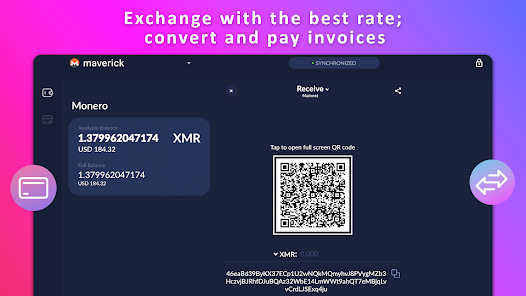
How the wallet stacks up: core mechanisms that matter
Start with custody: this wallet is fully non-custodial and open-source, meaning your private keys are generated and stored on your device. Device-level encryption leverages platform hardware (Secure Enclave on iOS, TPM on Android) and local authentication like a 4–6 digit PIN or biometrics. That architecture reduces server-side risk: developers cannot directly access your keys, and the project's zero-telemetry policy means they do not collect transaction histories or device identifiers. That’s a strong baseline for threat models centered on centralized data leaks.
Network privacy is the next layer. The wallet supports Tor-only mode and I2P, plus the option to use custom nodes. Those features stop casual IP-to-transaction linkage; if you always route traffic over Tor or I2P and use trusted nodes, third parties cannot easily correlate your IP to on-chain activity. Important boundary condition: Tor/I2P protects network-layer anonymity but not mistakes in on-chain operations (address reuse, metadata leakage). Network protection must be combined with conservative on-chain habits to produce robust privacy.
Coin-specific mechanics differ. Monero (XMR) is privacy-first by design—ring signatures, stealth addresses, and confidential transactions. The wallet keeps the private view key on-device and supports subaddresses and background synchronization; these are the mechanisms that preserve Monero’s fungibility while letting users manage multiple incoming streams without address reuse. For Bitcoin (BTC), the wallet provides tools like PayJoin v2, Silent Payments, UTXO coin control, and batching—these are privacy-enhancing but optional. For Litecoin (LTC), support for MimbleWimble Extension Blocks (MWEB) adds an optional confidential transaction layer; enabling MWEB changes how outputs are represented and how change is handled, which affects privacy and compatibility.
Built-in exchange: decentralized routing and the practical trade-offs
One of the biggest conveniences is in-app swapping: you can convert BTC, XMR, LTC, ETH and dozens of other assets without leaving the wallet. Technically this uses a decentralized routing system called NEAR Intents that automatically finds competitive rates among multiple market makers. That removes the need to trust a single centralized exchange for counterparty risk and limits custody exposure because you don’t have to deposit funds on an external platform.
But “decentralized routing” is not magic. The routing coordinator aggregates offers from market makers and assembles a path for swap execution; you still interact with external liquidity providers to complete trades. The privacy implications are twofold: first, the routing metadata could expose trade intent unless properly obfuscated; second, the success and rate quality depend on the available liquidity and the market makers’ behavior. In practice, NEAR Intents reduces single-point centralization risk but introduces complexity: you trade off some transparency about counterparties for improved rate competition and on-device custody retention. If preserving anonymity of the trade intent is paramount, combine swapping with Tor/I2P and consider splitting large swaps into smaller, staggered transactions to avoid drawing attention on-chain.
Operational limitation: certain coins impose migration frictions. For Zcash (ZEC), this wallet enforces mandatory shielding—sending only from shielded (z-) addresses—so outgoing transactions avoid transparent-address leaks. However, if you hold ZEC in a different wallet family (for example, a Zashi wallet), seed incompatibilities mean you cannot directly import the Zashi seed into this wallet; you must create a new ZEC wallet here and manually transfer funds. That’s a practical nuisance and a reminder: privacy features sometimes require more manual migration steps to preserve cryptographic guarantees.
Comparing Bitcoin, Litecoin, and Monero privacy in the same wallet
Comparative snapshot: Monero is privacy-native—protocol-enforced confidentiality means the wallet’s role is to preserve local key secrecy and avoid leaking view keys. Bitcoin offers privacy tools at the wallet layer, but they are heuristics layered on a transparent ledger—PayJoin and coin control reduce linkage but cannot eliminate it. Litecoin with MWEB offers optional confidential outputs similar in spirit to MimbleWimble, but adoption and interoperability are still evolving.
Decision rule: if your primary objective is plausible deniability and strong on-chain unlinkability, prefer Monero and treat BTC/LTC as requiring disciplined operational practices (address hygiene, use of PayJoin, controlling UTXO selection). If you need to swap between assets frequently while keeping custody, using an in-wallet decentralized swap is attractive—but maintain Tor/I2P and stagger swaps to reduce chain-analysis flags.
Attack surfaces and realistic failure modes
Even the best wallet has limits. Consider four categories of risk: device compromise, metadata leakage, liquidity-pathway risk, and protocol incompatibility. Device compromise remains the single largest practical threat: if malware or a physical attacker can extract your seed or intercept local biometric input, the hardware protections slow but do not wholly prevent extraction. Hardware wallet integration (Ledger, or an air-gapped device like Cupcake) raises the bar: cold signing keeps private keys off the online device and is the most reliable mitigation against remote theft.
Metadata leakage is subtle. Transaction graphs, timing, and on-chain clustering can deanonymize users even when payloads are shielded at the application level. The wallet’s Tor/I2P support and no-telemetry policy reduce discovery vectors, but on-chain behavior (repeated patterns, large one-off swaps) can still be analyzed. Avoid address reuse, avoid linking transparent and shielded addresses carelessly, and be cautious about broadcasting large, textbook-sized privacy-preserving transactions that stand out.
Liquidity-pathway risk concerns the in-app exchange: market makers are external parties and, in a worst-case, could attempt to correlate orders. Decentralized routing helps by splitting orders across makers and avoiding a single counterparty, but correlation attacks are theoretically possible. If you need regulatory-compliant transaction trails (for example, for tax reporting in the U.S.), maintain records separately and plan swaps to preserve evidence of provenance.
Practical heuristics and a decision framework
Here are reusable heuristics to decide what to do in common situations:
- Everyday small-value payments: use BTC with PayJoin and good UTXO control or use Litecoin with MWEB if recipient supports it; prefer Tor routing on public networks.
- Sensitive holdings and long-term storage: prefer Monero for privacy, and store large allocations in a hardware wallet or an air-gapped solution.
- Cross-asset rebalancing: use the in-wallet decentralized swap, but split large swaps and route through Tor/I2P to reduce network-level correlation.
- Migration or wallet changes: don’t assume seed compatibility between different wallet families (ZEC/Zashi example); always test small transfers first.
These rules are robust across typical U.S.-based threat models: law enforcement access to centralized servers, ISP-level metadata collection, and opportunistic cybercrime. They are not silver bullets: legal, regulatory, and institutional pressures can create disclosure demands or access vectors out of scope for technical countermeasures.
What to watch next — signals that would change how you operate
Three near-term signals matter. First, wider support for MWEB beyond Litecoin’s early adopters: broader merchant and exchange support would improve utility without sacrificing confidentiality. Second, improvements in decentralized swap routing that reduce observable routing metadata—if protocols evolve to use private commitment schemes for offers, swap privacy could materially improve. Third, any change in platform-level hardware security (e.g., changes to mobile Secure Enclave APIs) could affect device-level protections; watch OS vendor announcements and keep software updated.
These are conditional scenarios. None guarantees better privacy; they create possibilities. Your operational stance should adapt in response to changes in liquidity, protocol upgrades, or new adversary techniques.
FAQ
Q: Can I keep full privacy if I swap Monero for Bitcoin inside the wallet?
A: Not perfectly. Monero’s protocol conceals on-chain links, but when you swap into Bitcoin using decentralized routing, the resulting BTC outputs are on a transparent ledger. The wallet reduces correlation risk by using decentralized market makers and network privacy (Tor/I2P), but on-chain heuristics can still correlate timing and amounts. Best practice: break large conversions into multiple smaller swaps, use Tor, and avoid immediate spending patterns that mirror the original XMR deposits.
Q: Is the built-in exchange safer than using a centralized exchange?
A: It depends on the threat model. A decentralized in-wallet exchange reduces custodial risk because you never deposit funds to a third-party exchange. It also spreads counterparty exposure across multiple makers via NEAR Intents, lowering single-point failure. However, it introduces routing metadata and depends on external liquidity providers. If your primary concern is custody and centralized exchange seizure, the in-wallet swap is better. If you need regulatory compliance or large-volume guaranteed fills, a regulated centralized exchange may offer different advantages despite custody risk.
Q: How should I handle Zcash I hold in another wallet?
A: Because this wallet enforces mandatory shielding and has different change-address behavior than some other wallets (for example, Zashi), seed import may not work. Create a new ZEC wallet here and transfer funds manually, testing with a small amount first. That manual step preserves the shielded-address guarantees the wallet enforces.
Q: Are hardware wallets necessary if the mobile app uses Secure Enclave or TPM?
A: Hardware-backed key storage in Secure Enclave or TPM is strong and suitable for many users. External hardware wallets or air-gapped devices further reduce risk by keeping signing keys entirely offline, which matters if you face targeted attackers or high-value holdings. Treat hardware wallets as an extra layer, not a replacement for good operational hygiene.
If you want to test a privacy-first, multi-currency wallet that combines Monero support, Bitcoin privacy tools, Litecoin MWEB, decentralized swaps, and hardware-wallet integration, consider trying a vetted client and follow operational best practices—use Tor or I2P, update your app and OS, test migrations with small transfers, and leverage hardware signing for large holdings. For a direct starting point, find the official release and installation options here: cake wallet download.
In short: privacy-capable wallets have matured. They no longer require arcane skills to access useful protections, but they demand disciplined operational choices. Learn the mechanisms—what the wallet automates, what it leaves to you—and choose a workflow (hardware cold storage, Tor routing, strategic swaps) that matches the value you need to protect. That calibrated approach is the strongest practical path to meaningful privacy in 2026 and beyond.